Best Sprinklers Under $100
This post contains affiliate links. If you buy through one of them, we may earn a small commission at no extra cost to you. See our disclosure policy.
For medium yards in the 4,000-to-10,000-square-foot range, the $50-to-$100 tier is where coverage compromises mostly disappear. You get adjustable arc controls and heavier materials that survive freeze-thaw cycles in the Midwest and New England. Throw distances reach across a typical suburban lot without repositioning the unit twice.
Picking the right head is only half the job. If you want a full seasonal watering plan matched to your region’s grasses and climate, walks through the schedule month by month.
What to Look for at This Price Point
The sub-$50 bracket typically means thin plastic that cracks after two or three freeze-thaw cycles and adjustment tabs that strip before the second season. Spending between $50 and $100 addresses most of those failure points.
Coverage is the starting question. Most medium lawns need 4,000 to 5,500 square feet covered per zone. Check the rated coverage against your actual water pressure, which for most residential homes runs between 40 and 60 PSI. Rated coverage at 60 PSI can shrink 15 to 20 percent at 45 PSI, so measure before committing to a head size.
Material matters more than most product listings suggest. Metal sled bases and zinc-body heads outlast all-plastic units by several seasons, particularly in climates with hard winters or mineral-heavy water. In the Midwest and New England, the base and the nozzle retaining ring are typically the first components to show wear.
Adjustment controls separate a frustrating unit from a useful one. A friction-lock arc tab holds its position through weekly repositioning better than a set screw, which tends to strip after one season of regular handling.
Inlet diameter is the overlooked spec on most mid-range listings. A three-quarter-inch female inlet moves substantially more water than a half-inch one. On a 50-foot hose run from the spigot, inlet size has a real effect on throw distance and pattern uniformity.
Best Oscillating Sprinkler for Rectangular Yards
Oscillating bars are the workhorse choice for rectangular lawns across the Midwest and Southeast suburbs. Adjustable left-right stops let you land water exactly at the sidewalk or fence line without soaking the driveway all summer.
 FANHAO Heavy Duty Pulsating Lawn Sprinkler on Spike Base, 100% Metal Impact Sprinkler with Adjustable Spray Pattern for Lawn Yard Irrigation, 360 Degree Large Area Coverage, Covers Up to 5800 sq. ft — $33.98 covers up to 4,500
square feet. Look for a heavy sled base and individual nozzle cleaning ports.
A wide-mouth inlet at the spigot end prevents the hose from kinking mid-cycle.
FANHAO Heavy Duty Pulsating Lawn Sprinkler on Spike Base, 100% Metal Impact Sprinkler with Adjustable Spray Pattern for Lawn Yard Irrigation, 360 Degree Large Area Coverage, Covers Up to 5800 sq. ft — $33.98 covers up to 4,500
square feet. Look for a heavy sled base and individual nozzle cleaning ports.
A wide-mouth inlet at the spigot end prevents the hose from kinking mid-cycle.
One common mistake is setting the arc stops too wide on a narrow lot, which pushes water past the fence line and onto paving. Dial the end stops in close to the property edge on the first run, then adjust after you see the actual pattern under your home’s water pressure.
Best for Irregular Lots: Adjustable-Arc Sprinkler
If your yard is not a clean rectangle, an adjustable arc gives you control that no oscillating bar can match. Neighbors with angled property lines or mature trees that interrupt a straight throw get better coverage from a rotary or impact-style head than from any fixed-bar pattern.
 FANHAO Heavy Duty Pulsating Impact Lawn Sprinkler with Metal Base, 100% Metal 360°Adjustable Circular Zinc Impulse Sprinkler for Large Area Lawn & Yard Irrigation, Covers Up to 5800 sq. Ft — $35.99 handles up to
5,800 square feet on standard home water pressure. The low-angle throw also
resists wind drift, which matters on open Midwest lots and in the Southwest
where afternoon gusts are predictable.
FANHAO Heavy Duty Pulsating Impact Lawn Sprinkler with Metal Base, 100% Metal 360°Adjustable Circular Zinc Impulse Sprinkler for Large Area Lawn & Yard Irrigation, Covers Up to 5800 sq. Ft — $35.99 handles up to
5,800 square feet on standard home water pressure. The low-angle throw also
resists wind drift, which matters on open Midwest lots and in the Southwest
where afternoon gusts are predictable.
Rotary heads also handle slight grades better than oscillating bars. On a lot that drops a foot or two from one end to the other, a rotary placed at the high center covers the slope more evenly than an oscillating bar set at the low end.
Best for Windy Regions: Pulsating Impact Sprinkler
Pulsating (pulse-jet) heads throw water in a flat, low stream that wind cannot scatter the way it does a fan-spray or oscillating pattern. If you water during afternoon hours or live on an exposed lot, this style is the more consistent option.
FANHAO Heavy Duty Pulsating Impact Lawn Sprinkler with Metal Base, 100% Metal 360°Adjustable Circular Zinc Impulse Sprinkler for Large Area Lawn & Yard Irrigation, Covers Up to 5800 sq. Ft — $35.99 mounts on an adjustable
tripod that raises the head above tall grass and tilts for sloped terrain. This
style is common across Texas and the southern plains, where afternoon gusts can
waste a substantial share of any overhead spray application.
A tripod mount also resolves the dead-spot problem that flat-mounted pulsating heads sometimes create. Grass immediately below a head set at ground level can go under-watered because the stream arcs overhead. Raising the head eight to twelve inches on the tripod eliminates most of that center dry zone.
Best Gear-Driven Rotor: Quiet and Consistent
Gear-driven rotors cycle quietly and predictably. Timing is easier, and the slow delivery rate gives clay soils time to absorb without puddling along edges or running off into the street.
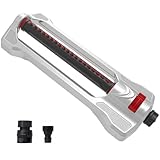 Lawn sprinklers for Yard, Lawn and Garden Covers Up to 3,200 sq. ft., Heavy Duty Metal Lawn Sprinkler with 19 Precision Nozzles, Adjustable Range Watering System with Independent Front & Back Control — $33.99 covers 2,000 to 3,800
square feet depending on pressure. Southeast and Pacific Northwest homeowners
dealing with compact soils see consistent results without the surface runoff
that a high-pressure impact head sometimes causes.
Lawn sprinklers for Yard, Lawn and Garden Covers Up to 3,200 sq. ft., Heavy Duty Metal Lawn Sprinkler with 19 Precision Nozzles, Adjustable Range Watering System with Independent Front & Back Control — $33.99 covers 2,000 to 3,800
square feet depending on pressure. Southeast and Pacific Northwest homeowners
dealing with compact soils see consistent results without the surface runoff
that a high-pressure impact head sometimes causes.
The slow cycle rate, typically one rotation every 30 to 40 seconds, also makes these easy to time manually. If you water in the early morning before leaving for the day, the predictable cycle lets you pull the unit after a set number of passes rather than watching a clock.
Setting Up Zones on a Medium Yard
One portable sprinkler on a long hose covers a medium yard in two or three moves per watering session. Folks who set a phone timer for 20-minute intervals find that a morning run takes less than an hour and does not require staying home the entire time.
Divide the yard into zones on paper before the first run. Sketch the lot, note where pressure seems lowest (usually the far end from the spigot), and place the sprinkler that needs the most throw distance there first. The unit at the far end is running on full line pressure rather than sharing flow with a second sprinkler running at the same time.
Avoid running two units on the same circuit simultaneously. Most home systems deliver 6 to 10 gallons per minute at the spigot. Split that flow across two sprinklers and neither one reaches its rated throw distance. Run one unit per zone and move it after the timer fires. In the first week it takes some attention, but once you know how long each zone takes to reach half an inch, the routine runs itself.
A rain gauge placed at mid-range from the head tells you when a zone has received enough. The guideline from most cooperative extension services is 1 inch of water per week during the growing season, counting rainfall. If the gauge shows a half-inch after a storm, run each zone for half the usual time that week.
Morning watering between 5 and 9 a.m. reduces evaporation loss compared to midday runs and limits the leaf wetness that encourages fungal pressure. This matters most in the Southeast and Pacific Northwest, where high overnight humidity already keeps turf surfaces damp. In drier climates like the Southwest and Texas, morning timing still saves a meaningful share of the water that midday evaporation would otherwise pull off the surface before it reaches the root zone.
Who Should Buy in This Range
Folks with medium-sized yards that have outgrown the $50 tier but are not yet ready to trench for an in-ground system. The hardware lasts several seasons and running two or three units in zones still costs far less than a permanent installation.
Neighbors who inherit a property with a failed or aging in-ground system also find that two or three portable units can bridge a full growing season while a replacement is quoted and scheduled. The upfront cost is low enough that it makes sense to run portables through the season before committing to a permanent layout.
Before locking in a watering schedule with a new sprinkler, it is worth reading through common overwatering mistakes to avoid stressing the lawn during the adjustment period. For lawns over 10,000 square feet or where water efficiency is the priority, in-ground-compatible rotors with integrated timers are worth considering at the next price tier.